

Learning is a complex process that involves much more than receiving information or memorizing facts. It is influenced by prior knowledge, cognitive development, motivation, social interaction, and the environment in which learning takes place.
What Is Educational Psychology?
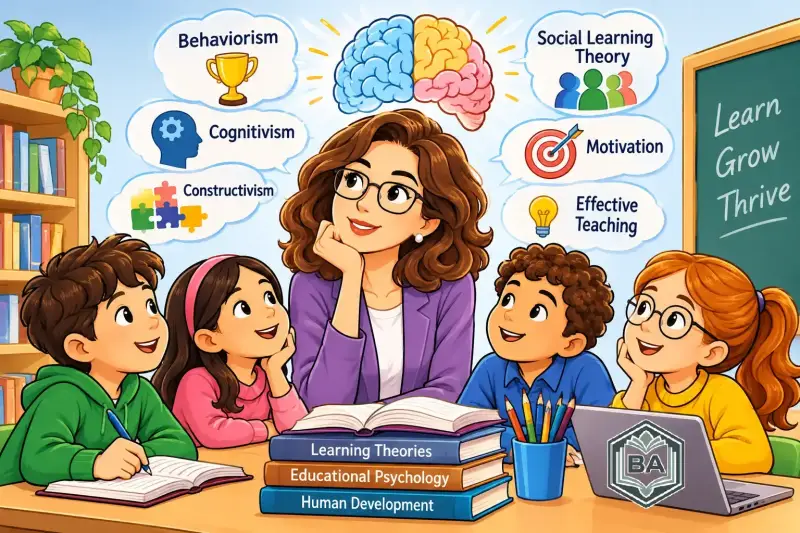
Educational psychology is the field that examines how people learn, develop, and behave in educational contexts. It explores the psychological processes involved in acquiring knowledge, developing skills, solving problems, and responding to educational experiences.
Drawing on research in psychology, education, and human development, educational psychology helps explain the relationship between learners, teaching practices, and learning environments.
The field is not limited to schools or childhood education. It also applies to higher education, professional training, adult learning, and lifelong development. By understanding the factors that influence learning, educators can make more informed decisions about teaching methods, assessment, and educational support.
Why Is Educational Psychology Important?
Education involves an interaction between learners, educators, knowledge, and the surrounding environment. Students bring different levels of prior knowledge, experiences, interests, and expectations into the learning process.
Educational psychology helps explain how these differences influence learning and why a particular teaching strategy may work well for one learner but be less effective for another.
For example, a student experiencing difficulties in mathematics may need more than additional practice. The underlying challenge could involve gaps in prerequisite knowledge, difficulties with information processing, low confidence, or insufficient opportunities for meaningful feedback.
Understanding these factors allows educators to consider the reasons behind learning difficulties rather than relying on academic performance alone.
Educational Psychology Contributes To:
- Understanding how learners acquire, process, and retain information.
- Recognizing individual differences in cognitive and social development.
- Examining the role of motivation and engagement in learning.
- Selecting appropriate teaching and assessment strategies.
- Creating supportive and inclusive learning environments.
- Developing independent thinking and lifelong learning skills.
The American Psychological Association's Top 20 Principles for Teaching and Learning explains how psychological research can inform areas such as thinking, learning, motivation, social-emotional development, classroom management, and assessment (American Psychological Association, 2025).
How Do People Learn? Four Important Learning Theories
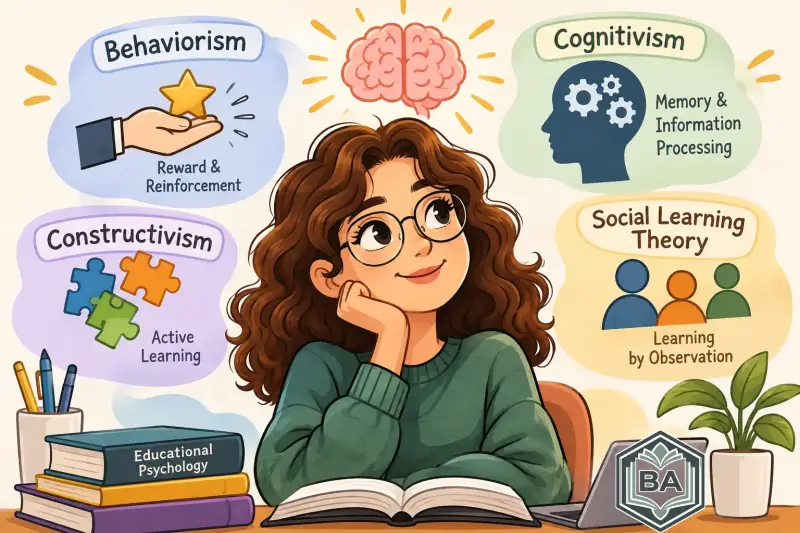
Learning theories offer different explanations of how individuals acquire knowledge, develop skills, and change their behavior. Each perspective emphasizes particular aspects of the learning process.
The four perspectives discussed below—behaviorism, cognitivism, constructivism, and social learning theory—provide useful ways to understand learning and inform educational practice. They are not the only theories of learning, and they should not be treated as interchangeable or as a complete explanation of every learning situation.
Understanding the Learning Process: From Prior Knowledge to Application
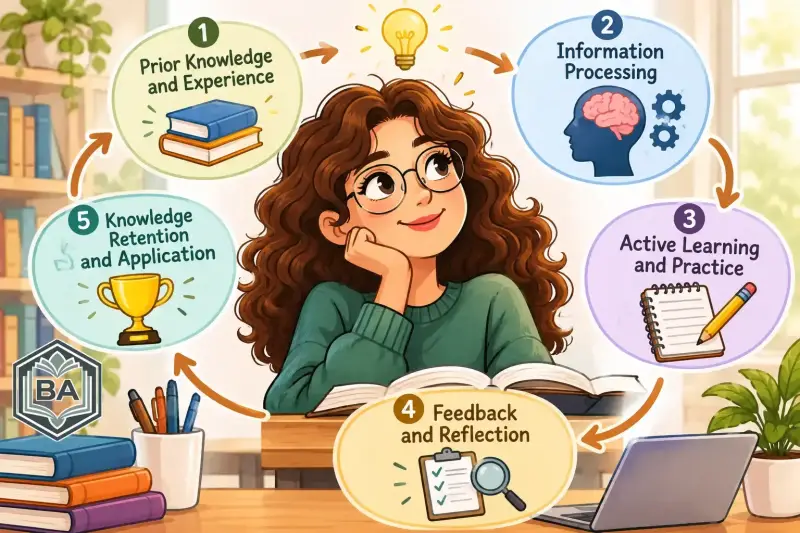
Learning can be understood as a process in which individuals connect previous experiences with new information, develop understanding, and gradually apply what they have learned.
Figure 1
A Simplified Conceptual Model of the Human Learning Process
Learners begin with existing knowledge, experiences, and ideas that influence how they interpret new information.
New information is received, interpreted, organized, and connected with existing knowledge through cognitive processes such as attention and memory.
Learners develop understanding through activities such as problem-solving, discussion, experimentation, and practical application.
Feedback and reflection help learners identify misunderstandings, evaluate their progress, and improve their understanding.
Through meaningful practice and retrieval, learners may retain knowledge and apply it in new situations and contexts.
Note: This five-stage diagram is an original, simplified conceptual illustration prepared for this article. It is not a validated standalone learning theory or a universal sequence. In practice, learning is often iterative: individuals may return to earlier stages, reconsider previous knowledge, and revise their understanding as they gain new experiences.
Understanding these interconnected processes provides a useful foundation for exploring the major learning theories discussed below.
1. Behaviorism: Learning Through Experience and Feedback
Behaviorism focuses on observable behavior and how it changes through interactions with the environment.
From a behavioral perspective, reinforcement and feedback can influence the likelihood that a particular behavior will occur again. Learning can therefore be examined through observable changes in performance under different conditions.
In educational settings, teachers may use positive reinforcement to encourage participation, consistent practice, and productive learning behaviors.
For example, specific and timely feedback can help students recognize successful approaches and understand which areas require further improvement.
Behaviorism provides useful explanations for practice, reinforcement, and skill development. However, it does not independently explain every aspect of learning, particularly complex mental activities such as reasoning, creativity, and conceptual understanding.
2. Cognitivism: Understanding How the Mind Processes Information
Cognitive perspectives examine the mental processes involved in learning, including attention, memory, perception, reasoning, and problem-solving.
From this perspective, learning involves organizing and interpreting information, connecting new knowledge with existing understanding, and retrieving information when needed.
Teachers can support these processes by:
- Dividing complex information into manageable sections.
- Connecting unfamiliar concepts with previous knowledge.
- Using diagrams and meaningful examples.
- Encouraging students to explain concepts in their own words.
- Providing opportunities for practice and knowledge retrieval.
These approaches can help learners develop a deeper understanding of educational material rather than relying exclusively on memorization.
3. Constructivism: Building Knowledge Through Active Learning
Constructivist perspectives emphasize the active role of learners in developing understanding.
Rather than simply receiving information, learners interpret new experiences, connect them with existing knowledge, and gradually develop more organized explanations of the world.
For example, in a science lesson, students might investigate a question, conduct an experiment, observe the results, and discuss possible explanations.
The teacher supports this process by providing guidance, asking meaningful questions, and helping students evaluate their understanding.
Constructivist approaches are particularly relevant to inquiry-based learning, problem-solving activities, and collaborative educational experiences.
4. Social Learning Theory: Learning Through Observation and Interaction
Social learning theory, associated with psychologist Albert Bandura, emphasizes the role of observation, modeling, and social experience in learning.
Individuals can acquire new behaviors and skills by observing other people and considering the consequences of their actions.
In educational environments, students may learn by observing how teachers demonstrate a task, how classmates approach a problem, or how others communicate and respond to challenges.
Examples include:
- Teacher demonstrations.
- Peer learning activities.
- Group discussions.
- Collaborative projects.
- Observational learning through practical examples.
Social learning highlights the importance of relationships and interaction in educational development.
Comparing Four Learning Perspectives
| Learning Perspective | Main Focus | Educational Example |
|---|---|---|
| Behaviorism | Observable behavior and reinforcement | Feedback and positive reinforcement |
| Cognitivism | Memory and information processing | Organizing concepts and retrieval practice |
| Constructivism | Active knowledge construction | Inquiry-based projects |
| Social Learning Theory | Observation and modeling | Peer learning and teacher demonstrations |
These perspectives are not necessarily competing approaches. Educators can draw on different theories depending on learning objectives, subject matter, and the needs of their students.
The descriptions in this section are informed by educational theory resources from Indiana University's School of Education and the open textbook Educational Learning Theories by Zhou and Brown.
References for further reading:
- Indiana University – Common Theories in Teacher Education Programs
- Zhou and Brown – Educational Learning Theories: 2nd Edition
The Role of Motivation in Learning
Motivation influences how learners approach educational tasks, how much effort they invest, and whether they continue when difficulties arise.
Two commonly discussed forms of motivation are intrinsic and extrinsic motivation.
Intrinsic and Extrinsic Motivation
Intrinsic motivation refers to engagement driven by personal interest, curiosity, or satisfaction derived from the activity itself.
Extrinsic motivation involves external influences such as grades, recognition, awards, or other incentives.
Both forms can influence educational engagement. However, effective teaching should also create opportunities for curiosity, independence, personal development, and meaningful participation.
Teachers can support motivation by:
- Establishing clear and achievable learning objectives.
- Providing constructive and informative feedback.
- Connecting educational content to real-life experiences.
- Encouraging student participation and independence.
- Creating an environment where questions and mistakes are treated as opportunities for learning.
A supportive classroom environment can also influence students' willingness to participate, communicate, and engage with challenging material.
Cognitive Development and Individual Differences
Cognitive development involves changes in mental abilities such as attention, memory, language, reasoning, and problem-solving.
These processes develop through interactions between individual characteristics, previous experiences, and environmental influences.
Learners may differ in their prior knowledge, language backgrounds, educational experiences, interests, and access to learning resources. These differences can influence how they understand information and respond to teaching methods.
Educational psychology helps educators consider these variations when designing learning activities and selecting appropriate instructional strategies.
Recognizing individual differences does not mean assigning students to fixed learning categories. Instead, it involves providing flexible educational opportunities that allow learners to understand, practice, and demonstrate knowledge in different ways.
These connections between educational psychology, curriculum development, and human development are also relevant to the academic interests of Dr. Baharak Azami.
With an academic background in Curriculum Studies and Educational Technology, and more than twenty years of university teaching experience, Dr. Azami's professional work reflects an interest in the relationship between educational environments, learning experiences, and human development.
Learn more about Dr. Baharak Azami's academic background and educational work.
Educational Psychology in 2026: Artificial Intelligence and the Science of Learning
Artificial intelligence is introducing new possibilities for teaching, learning, and educational support.
Generative AI tools can help explain complex concepts, provide alternative examples, support lesson preparation, and assist learners in exploring unfamiliar topics.
However, completing a task successfully with the assistance of AI does not necessarily mean that meaningful learning has taken place.
The OECD's Digital Education Outlook 2026: Exploring Effective Uses of Generative AI in Education discusses how generative AI can support learning when guided by clear teaching principles. It also warns that using AI without appropriate pedagogical guidance may improve task performance without producing genuine learning gains (OECD, 2026).
AI Use and Teachers' Perspectives
According to the OECD's reporting of the 2024 TALIS survey, findings for lower secondary teachers:
Teachers who reported using AI for their work in 2024.
Teachers who agreed that AI helps write or improve lesson plans.
Teachers who believed AI could harm academic integrity by allowing students to present AI-generated work as their own.
Source: OECD Digital Education Outlook 2026, reporting findings from the 2024 TALIS survey.
These findings highlight both the opportunities and challenges associated with AI in education.
For example, students can use AI to compare explanations, explore different approaches to a problem, or identify gaps in their understanding. Teachers can also use these tools to prepare practice questions and develop alternative explanations.
Nevertheless, AI-generated information requires human evaluation. Accuracy, relevance, fairness, privacy, and alignment with educational objectives remain important considerations.
UNESCO's Guidance for Generative AI in Education and Research emphasizes a human-centered approach to the use of these technologies, including attention to privacy, ethical considerations, and appropriate educational guidance (Miao & Holmes, 2023).
The central challenge is therefore not simply to introduce more technology into education, but to ensure that technological tools support meaningful learning, independent thinking, and responsible educational practice.
How Can Teachers Apply Educational Psychology?
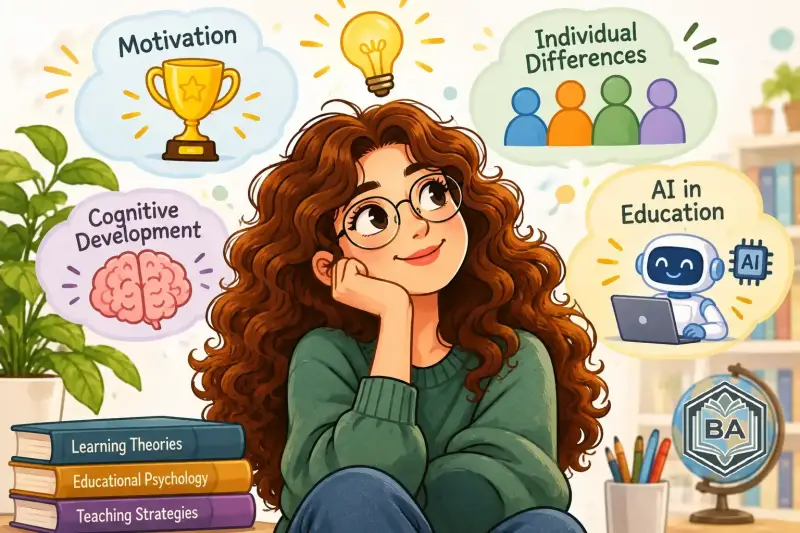
Educational psychology becomes especially valuable when its principles are translated into everyday teaching practices.
Teachers can apply its insights in several ways:
- Identify prior knowledge: Understand what students already know before introducing more advanced concepts.
- Use varied instructional strategies: Combine explanations, discussions, visual materials, practical activities, and problem-solving.
- Provide meaningful feedback: Explain students' strengths and areas for improvement rather than relying exclusively on grades.
- Encourage active participation: Give learners opportunities to ask questions, investigate ideas, and contribute to discussions.
- Consider individual development: Recognize differences in experience, confidence, knowledge, and educational needs.
- Use technology purposefully: Select digital tools and AI applications according to clearly defined learning objectives.
These practices can contribute to more responsive learning environments in which understanding, participation, and development receive appropriate attention.
The Future of Educational Psychology
Educational psychology continues to develop alongside changes in society, technology, and educational practice.
Research into cognition, motivation, social interaction, human development, and digital learning environments will remain important for understanding how people acquire and apply knowledge.
The increasing availability of artificial intelligence also raises new questions about independent thinking, educational assessment, digital literacy, and the responsibilities of teachers and learners.
Technology may expand access to educational resources, but its effectiveness depends on how it is integrated into teaching and learning.
Future educational approaches will therefore need to balance technological opportunities with evidence-informed teaching practices, meaningful human interaction, and an understanding of individual development.
Ultimately, educational psychology provides a framework for examining learning as a complex human process shaped by cognitive abilities, personal experiences, social relationships, and educational opportunities.
Frequently Asked Questions
What is educational psychology in simple terms?
Educational psychology is the study of how people learn and develop in educational environments. It examines thinking, memory, motivation, behavior, and the factors that influence learning.
What are the main learning theories in educational psychology?
Four important perspectives include behaviorism, cognitivism, constructivism, and social learning theory. Each offers a different explanation of how people acquire knowledge and develop skills.
Why is educational psychology important for teachers?
It helps teachers understand learners' needs, select appropriate instructional strategies, support motivation, provide meaningful feedback, and create effective learning environments.
How does educational psychology relate to human development?
Educational psychology examines how cognitive, emotional, and social development influence learning across different stages of life. It helps educators understand how learning experiences can support intellectual and personal development.
How is artificial intelligence changing educational psychology?
AI provides new opportunities for educational explanations, feedback, and learning support. However, its effectiveness depends on responsible use and appropriate educational guidance. AI should support active thinking rather than replace learners' own reasoning.
References
The following sources provide further information on educational psychology, learning theories, and the use of artificial intelligence in education.
- American Psychological Association. (2025). Top 20 Principles for Teaching and Learning . American Psychological Association.
- Indiana University School of Education. (2021). Common Theories in Teacher Education Programs . Indiana University.
- Zhou, M., & Brown, D. (2015). Educational Learning Theories: 2nd Edition . Education Open Textbooks, University System of Georgia.
- OECD. (2026). OECD Digital Education Outlook 2026: Exploring Effective Uses of Generative AI in Education . OECD Publishing.
- Miao, F., & Holmes, W. (2023). Guidance for Generative AI in Education and Research . UNESCO.
This article explores educational psychology through established learning perspectives, research on motivation and cognitive development, and emerging developments in artificial intelligence and education.
Add comment
Comments